Sensing the presence, position and movement of people in a room, without a camera, a microphone, or anything they need to wear.
Request a briefingThe technology
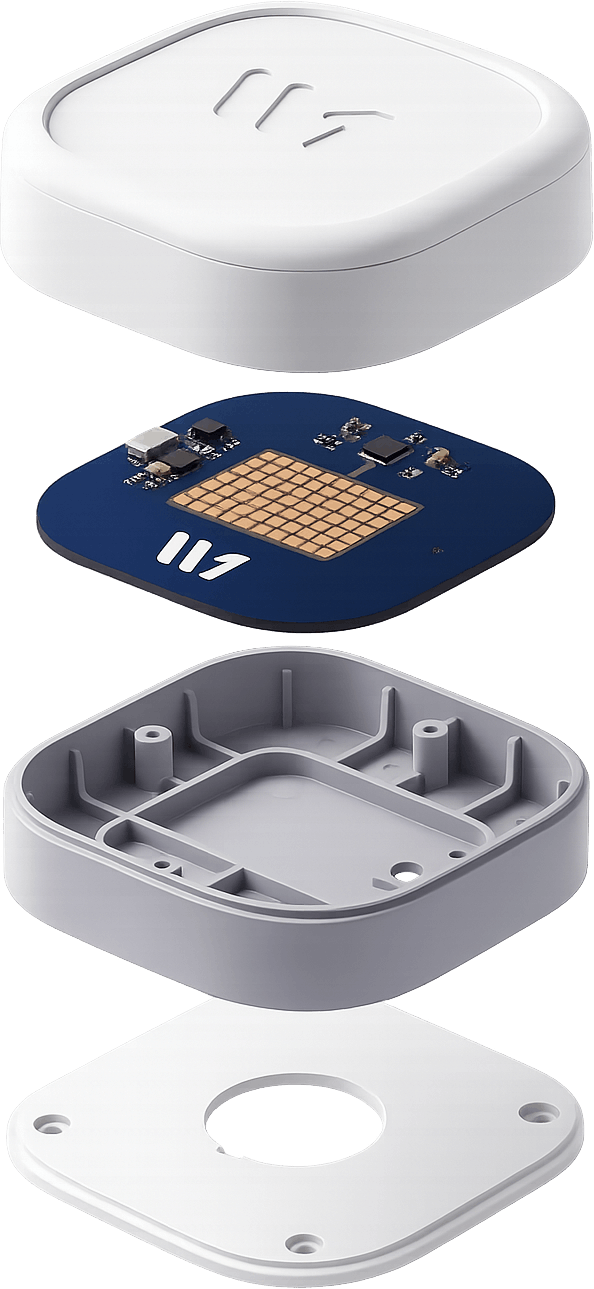
Ultra-wideband radar sends very short, low-power radio pulses across a wide band of frequencies, then reads the faint reflections that return from people and objects in a space. From those reflections it builds a precise picture of where a person is and how they are moving, many times a second.
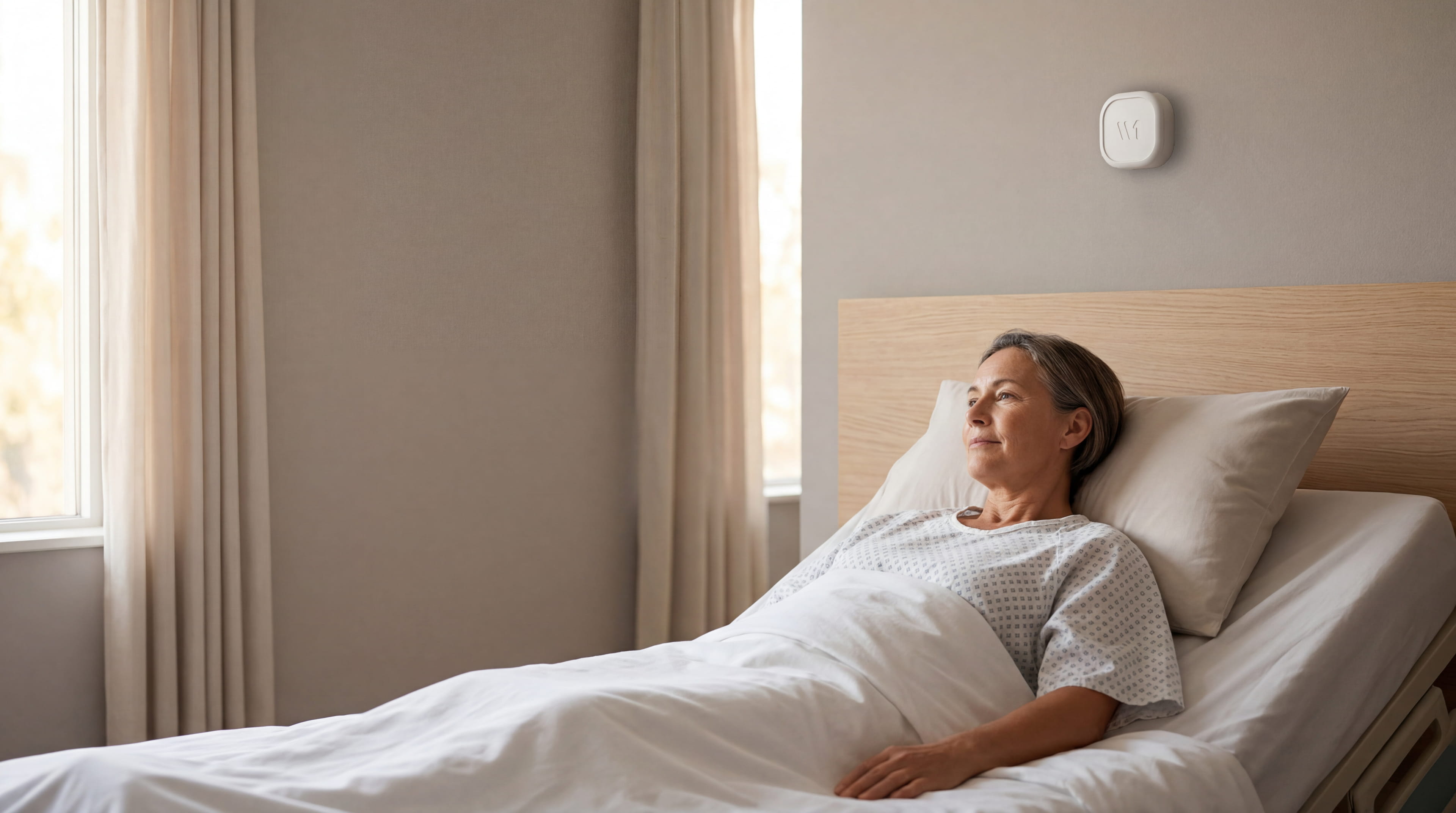
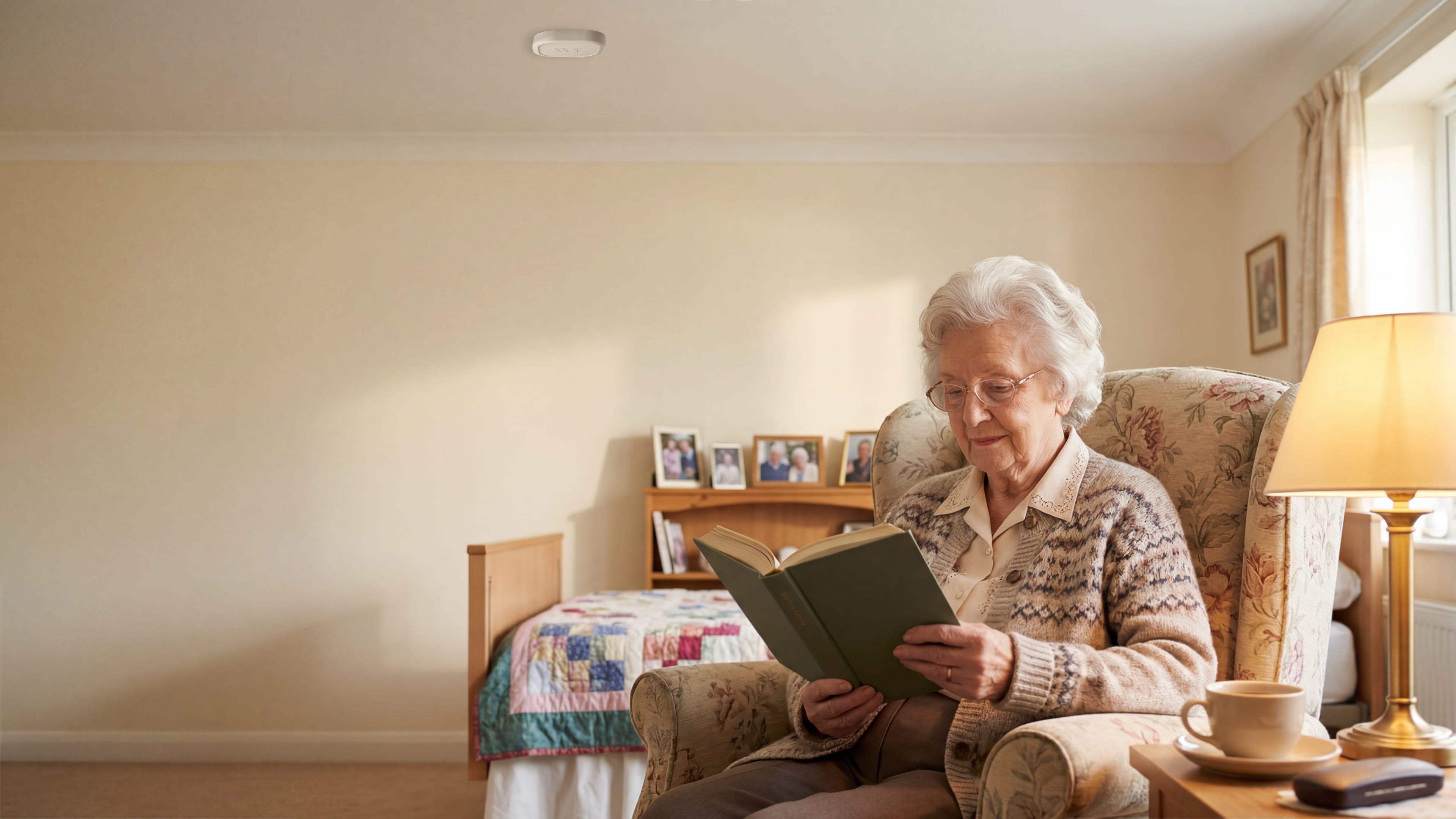
Because it works with radio rather than light, it captures no image and needs no line of sight. A single ceiling-mounted unit resolves presence, position and movement across an entire room, through bedding and clothing, in complete darkness, without anything in the room the occupant can see, touch, or interact with.
The wide frequency band is what gives the signal its precision. It separates one person from another, distinguishes a still occupant from an empty room, and picks up movement fine enough to tell a settled sleeper from a room that has gone quiet for the wrong reason.
At a glance
Where each approach stands on the things that matter for welfare sensing. The detail behind each one follows below.
| Property | Camera | Infrared / laser | Millimetre-wave | Ultra-wideband |
|---|---|---|---|---|
| No image captured | No | Yes | Yes | Yes |
| Works in darkness | No | Yes | Yes | Yes |
| Senses through bedding [3] | No | No | Partial | Yes |
| Whole-room coverage | Partial | No | Partial | Yes |
| Fine-movement resolution [1] | Partial | No | Partial | Yes |
In detail
Camera-based optical
OpticalWhat it is
A video sensor that builds a moving image of the room from visible or near-infrared light.
Strengths
Rich, detailed footage from a mature, widely understood technology.
Where it struggles
A camera captures an identifiable image of a person at their most vulnerable, which carries a serious privacy and dignity cost in care and clinical settings and is the subject of growing objection. It needs a clear view of the person, so it is defeated by bedding or a turned back, and it sees little in darkness without switching to infrared.
Infrared / laser
OpticalWhat it is
Sensors that read reflected infrared light, or measure distance with laser ranging, to detect movement and range.
Strengths
No image is captured, it works in darkness, and it is inexpensive to deploy.
Where it struggles
It depends on an unobstructed line of sight and is easily blocked by furniture, bedding or a partition. It reads movement rather than a person, so a still occupant can fade from view, and it gives little sense of where in the room someone is.
Millimetre-wave radar
RadarWhat it is
A radar operating at very high frequencies, giving fine resolution over a comparatively short range.
Strengths
No image is captured, it works in darkness, and it resolves movement well at close range.
Where it struggles
Its shorter range and weaker ability to pass through materials make whole-room coverage and through-bedding sensing harder than with a lower, wider band. Reliable coverage of a full room can take more units, more carefully placed.
Ultra-wideband radar
Our approachWhat it is
Short, wide-band radio pulses that resolve presence, position and movement across a whole room from a single unit.
Strengths
No image, works in darkness, senses through bedding and clothing, covers a whole room, and resolves fine movement, all from one coherent signal.
The result
One sensing modality that does the work several others can only approximate in combination. That coherence is what turns continuous sensing into alerts staff can trust.
What it means in practice
A welfare alert is only useful if staff can act on it without hesitation. A single high-resolution sensing modality gives a cleaner, more interpretable basis for deciding whether a room needs attention than a stack of different sensor types whose readings have to be reconciled, and whose weaknesses show up in different places. When one signal already resolves presence, position and movement together, there is less to disagree about and less to miss.
The cost of a false alarm
Every nuisance alert spends a little of the trust an alerting system depends on, and pulls staff away from where they are genuinely needed. Sensors that disagree with one another are a common source of them.
The cost of a missed event
The still person a motion sensor stops seeing, or the covered person a camera cannot read, is the gap that matters most. One signal that senses through bedding and holds onto a motionless occupant is how that gap closes.
The evidence
The properties described on this page are documented in peer-reviewed studies of ultra-wideband radar sensing.
References describe the capabilities of ultra-wideband radar as a sensing technology.
We will walk you through how contactless radar sensing applies to your setting, and what it would look like in practice.
Request a briefing